International medical experiences equip a Korean doctor to improve local healthcare < Policy < Article
International health is often perceived merely as “providing medical support overseas,” a view that overlooks its relationship to domestic health policies.
However, Dr. Park Geon-hee, director of Pyeongchang County Health Center, explained that his experiences of medical realities in countries such as Laos, Fiji, and the Philippines—lessons not found in textbooks—have convinced him that knowledge gained in international health settings can also drive change in domestic medical practice.
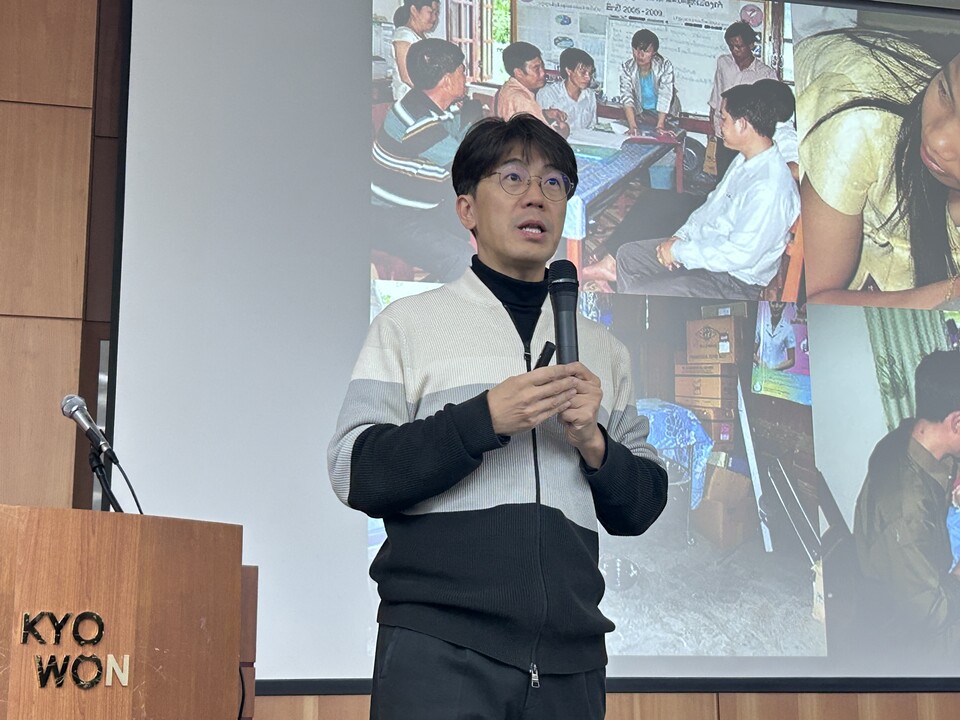
Dr. Park delivered a lecture titled “International Health and Community Health You Can’t Learn from Books” at the “KMI-Korean Doctors Weekly Global Health Leadership Camp” held at Kyowon Gapyeong Vision Center, Gyeonggi Province, from Friday to Saturday. He shared vivid field stories about international and community health with medical students.
A Korean doctor treated foreign patients in remote areas
Dr. Park, a specialist in preventive medicine, worked in international medical fields after completing his Ph.D. in public health in 2009. He spent three years in Laos, two years in the Philippines, and three years in Fiji in the South Pacific.
He returned to Korea in 2017, serving as director of the Ansan Public Health Center and head of the Infectious Disease Management Division at the Gyeonggi Provincial Office before joining the Pyeongchang County Health Center in 2022.
Dr. Park often worked in hard-to-reach health settings abroad. In Fiji’s island villages, roads stopped before the mountains, so he traveled by boat. In Laos, the absence of bridges meant entire areas were inaccessible for months during the rainy season. When lodging was unavailable, he stayed on beds at local health stations while working in the field.
He visited local health stations—not hospitals—where trained nurses provided primary care in areas without doctors. These nurses recorded population sizes, counts of mothers, children, and patients with hypertension or diabetes in their villages, and managed residents’ health in collaboration with village health workers. Director Park helped them work more effectively. His main activities also included prenatal education, improving delivery environments, maintaining vaccine storage, and supporting transportation and travel costs.
Dr. Park recalled his early days working in Laos. Only 25 percent of mothers gave birth with medical personnel present. The maternal mortality rate was 400 per 100,000 live births, and the under-five mortality rate was 100 per 1,000 children. Infectious diseases, including diarrhea and pneumonia, and insufficient vaccinations, were the primary causes.
By promoting prenatal care and vaccination with local health workers, maternal and child health indicators improved. “In international health, the crucial thing is not direct treatment, but ensuring the local health system functions,” Dr. Park noted.
Drawing from experience, Park says international health is more than aid—governments, civil groups, and business each play distinct global roles. “International health is mutual cooperation and requires shaping health policy as a global community,” Park explained.
What Korea will experience in the future is a reality in Pyeongchang today
After leaving international health and returning home, Dr. Park now works in Pyeongchang, Gangwon Province, host of the 2018 Winter Olympics.
Pyeongchang covers 2.4 times Seoul’s area but has fewer than 40,000 people. Its largest group is those in their 60s; over 1,000 turn 65 yearly, yet births are under 100.
Park called Pyeongchang “the most advanced demographic structure in Korea.” The county now faces challenges that Korea will see nationwide in 10–20 years.
Park said annual costs for a healthy person are 500,000 won ($350), rising to 2 million won with hypertension or diabetes, and up to 20 million won with complications, mostly from long-term care.
He noted there are no incentives for professionals who maintain patients’ annual costs at 500,000 or 2 million won—no reward for prevention.
Therefore, Dr. Park initiated new activities in Pyeongchang. He focuses on preventing disease progression through exercise and nutrition to combat sarcopenia, as well as smart health management. Major programs include strength training to reduce falls and fractures, and continuous monitoring with Bluetooth blood pressure and glucose monitors.
Park explained that prevention-focused management is crucial to stop hypertension and diabetes patients from developing complications. He emphasized that although this approach is led by the public sector, it must also work in private primary care.
Healthcare lessons learned in the field, instead of books
Director Park stated that, based on his experience, international and community health are not separate; both focus on finding solutions in real-world settings where people live. He also noted that physicians with clinical expertise can contribute across sectors—government, civic groups, and the private sector—both domestically and internationally.
“The key lesson: view health in societal, not individual, terms,”Park said. “But with AI transforming healthcare, we must not maintain the status quo.”
Park continued, “Just as nurses, nutritionists, and exercise specialists collaborate in multidisciplinary care, AI will also play a role in enhancing work efficiency.”
He added, “In primary care, doctors lead teams. Leadership needs training, not just experience. We must grow skills like leadership, communication, and negotiation.”
link